

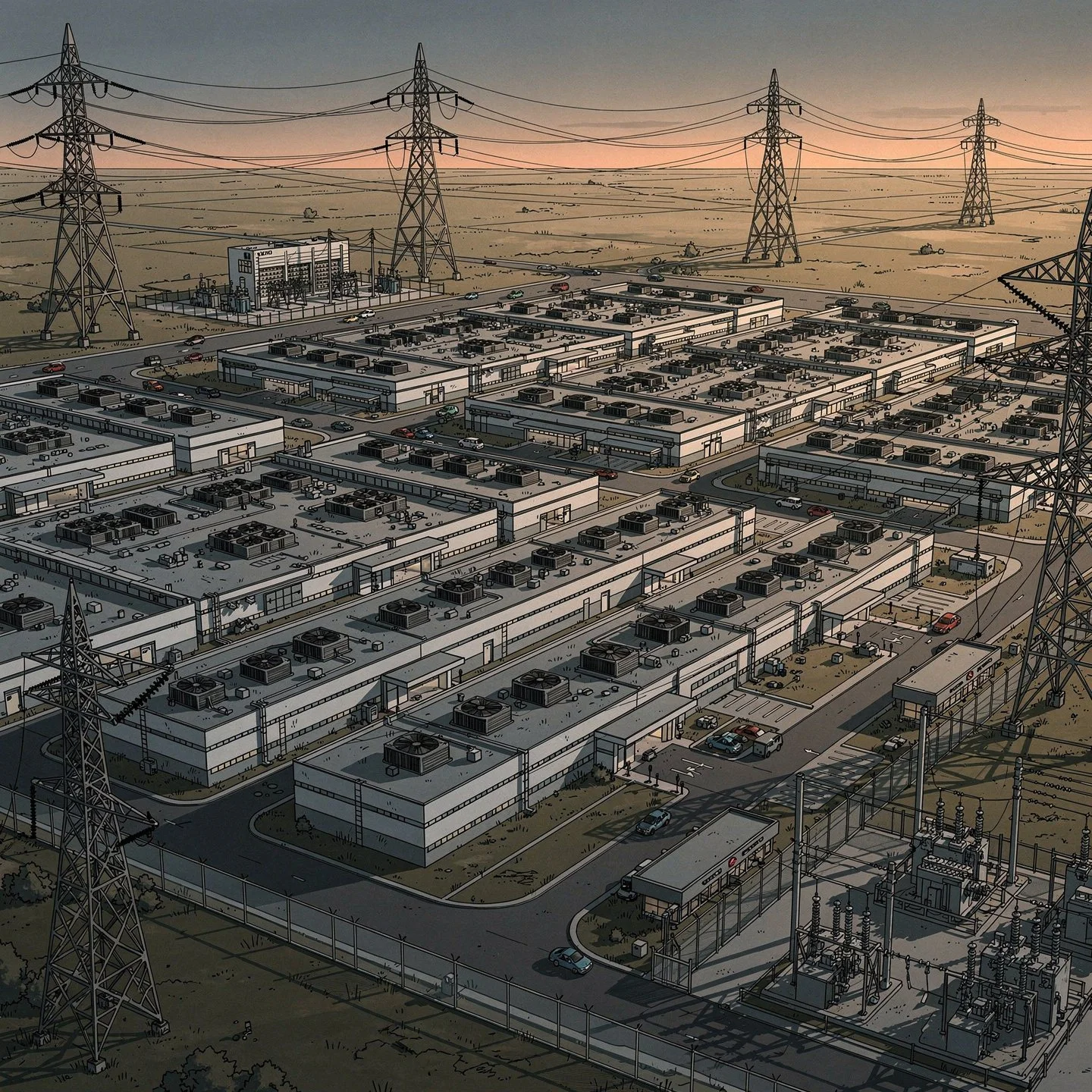
AI Waves™ Inaugural Edition: Why AI Is Becoming an Infrastructure Story
Tracking how AI constraints migrate into physical infrastructure systems over time.
Research Brief • June 2026
Introduction
Most discussions about artificial intelligence focus on models, chips, and software.
Yet as AI systems move from experimentation to large-scale deployment, a different reality is emerging.
The challenge is no longer solely creating intelligence.
Increasingly, the challenge is deploying intelligence.
Data centers require power. Power requires generation, transmission, substations, cooling systems, permitting, labor, and coordination. As AI expands, pressure moves through each of these systems in sequence.
This observation forms the foundation of the AI Waves™ framework.
AI Waves™ is a research framework designed to track how AI constraints migrate through infrastructure systems over time.
Its central thesis is simple:
AI bottlenecks do not disappear when solved. They migrate.
As one constraint is relieved, pressure accumulates elsewhere.
The result is a cascading sequence of dependencies that increasingly resembles an infrastructure buildout rather than a traditional software cycle.
Why AI Waves Exists
Technology narratives often focus on breakthroughs.
Infrastructure narratives focus on dependencies.
The AI Waves framework was created to answer a different question:
Where does pressure move next?
Historically, the dominant constraints on AI were concentrated in compute.
Organizations competed for:
GPUs
accelerator access
training capacity
data-center space
As those constraints improved, new bottlenecks emerged.
Power became scarce.
Interconnection queues expanded.
Substation construction timelines stretched.
Cooling systems became harder to secure.
Skilled labor became increasingly valuable.
The important observation is not any individual bottleneck.
The important observation is that the bottlenecks migrated.
AI Waves exists to track that migration.
The Constraint Migration Thesis
AI infrastructure is not a single-bottleneck problem.
It is a constraint migration process.
Each solved bottleneck exposes the next.
The progression often follows a recognizable pattern:
Compute
↓
Power
↓
Transmission
↓
Cooling
↓
Labor
↓
Coordination
As AI systems scale, the constraints shaping deployment move outward from software into physical systems.
This migration process is the organizing principle behind the framework.
Constraint Migration In Practice
Northern Virginia
The clearest example is Northern Virginia.
The region hosts the world's largest concentration of data-center infrastructure and an estimated 25–30% of U.S. hyperscale capacity.
The sequence closely mirrors the framework.
Phase 1: Compute Demand Concentrates
Hyperscaler investment accelerated rapidly between 2021 and 2024.
AI workloads concentrated within a single regional power market.
Phase 2: Power Becomes the Constraint
Electricity demand began growing faster than substation and transmission capacity.
Large-load interconnection requests accumulated.
Infrastructure timelines lengthened.
Phase 3: Transmission Becomes the Constraint
Regional planning systems struggled to keep pace.
Interconnection queues expanded.
Transmission upgrades became critical.
The bottleneck migrated.
Northern Virginia is not important because it is unique.
It is important because it appears to be early.
The Synchronization Problem
The deeper challenge is timing.
Compute and infrastructure operate on fundamentally different clocks.
Compute
global supply chains
modular deployment
measured in months
Infrastructure
permitting
transmission
substations
measured in years
A GPU cluster can be deployed rapidly.
A transmission corridor cannot.
This creates a synchronization problem.
Compute moves in quarters. Infrastructure moves in years.
The faster AI scales, the more visible this mismatch becomes.
The Five Waves
The framework organizes these dependencies into five research domains.
Wave 1 — Compute Buildout
The origin layer.
Accelerators, hyperscalers, training infrastructure, and data-center expansion.
Current status: Active and observable.
Wave 2 — Energy & Physical Infrastructure
Power generation.
Transmission.
Substations.
Cooling systems.
Construction capacity.
Labor availability.
Current status: Active and observable.
This is the primary constraint frontier today.
Wave 3 — Operational Ecosystems
As infrastructure scales, coordination becomes increasingly important.
Areas monitored include:
flexible load balancing
energy-aware orchestration
industrial coordination software
digital twins
AI-native orchestration
Current status: Emerging and monitored.
Wave 4 — Sector Intelligence Systems
AI becomes embedded within operational systems.
Examples include:
healthcare
logistics
manufacturing
defense
Current status: Long-duration research domain.
Wave 5 — Civilization Infrastructure Coordination
The outer horizon.
Areas monitored include:
energy systems
compute systems
logistics networks
robotics
autonomous coordination
Current status: Long-duration research domain.
What We Are Watching
Several emerging signals deserve particular attention.
Labor Constraints
Recent workforce initiatives from major technology companies suggest labor availability is becoming a meaningful deployment variable.
Electricians.
HVAC specialists.
Linemen.
Substation engineers.
Construction crews.
Infrastructure cannot scale without them.
Political Acceptance
AI infrastructure is becoming politically visible.
Communities are increasingly debating:
power usage
water consumption
noise
land use
tax incentives
Infrastructure deployment may eventually depend as much on local acceptance as on capital availability.
Regional Replication
Northern Virginia is no longer the only example.
Similar patterns are emerging across Texas and other major data-center markets.
The question is no longer whether constraint migration exists.
The question is how quickly it spreads.
Closing Thesis
AI may increasingly behave less like a software cycle and more like a long-duration infrastructure buildout.
The central observation of AI Waves™ is not that artificial intelligence will transform civilization.
The observation is narrower.
AI deployment at scale increasingly exhibits the characteristics of infrastructure expansion.
It depends on physical systems.
It operates on construction timelines.
It creates regional bottlenecks.
It accumulates long-duration capital dependencies.
The framework does not attempt to predict outcomes.
Its purpose is to track where pressure moves next.
AI bottlenecks do not disappear when solved.
They migrate.
Sources
Primary and secondary source categories referenced in this research brief include:
EPRI
FERC Order 2023
PJM Interconnection
EIA
Lawrence Berkeley National Laboratory
Rocky Mountain Institute
McKinsey Global Institute
S&P Global
Reuters
Utility and Grid Research
Related Research
Available
The Missing Category: Why AI Energy & Infrastructure Deserves Its Own Category
Editor's Note (June 2026)
This article was updated following the publication of AI Energy & Infrastructure (AIEI) Special Report #1.
The AI Waves framework continues to evolve as new evidence emerges across AI infrastructure, energy systems, workforce development, and large-scale deployment.
This edition reflects our current thinking regarding constraint migration, deployment bottlenecks, and the role of physical infrastructure in scaling intelligence.